Global Supply Chain | Sourcing Strategy | Taiwan Manufacturing
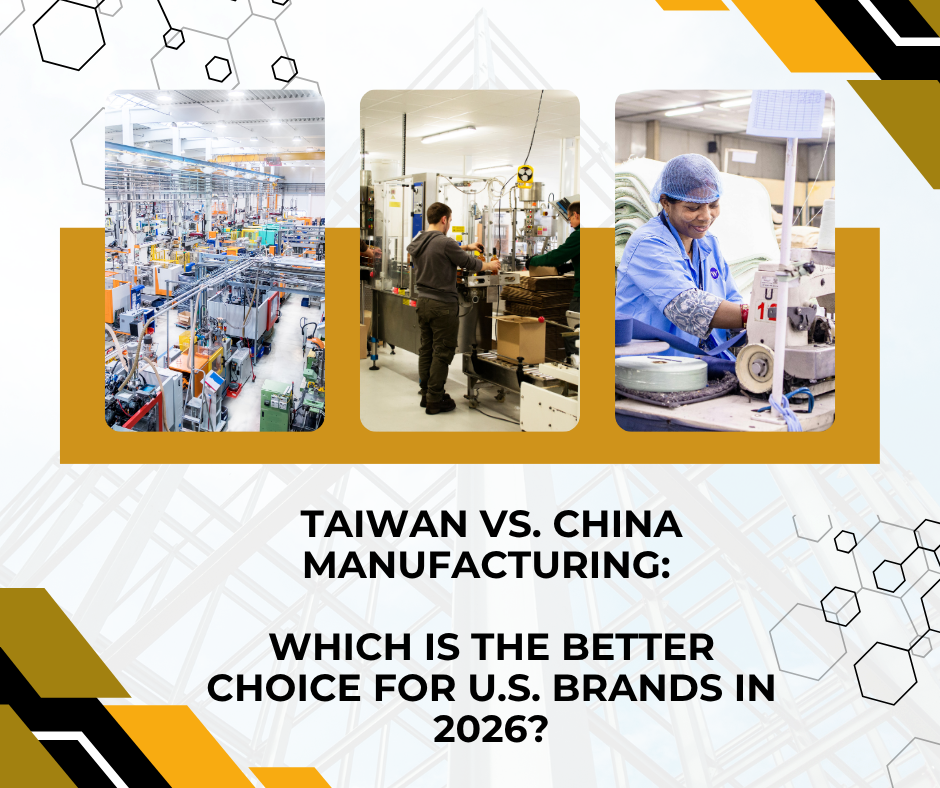
Taiwan vs. China Manufacturing: Which Is the Better Choice for U.S. Brands in 2026?
For decades, China has been known as the world’s manufacturing powerhouse. Its massive production capacity, extensive supplier network, and cost advantages helped thousands of global brands scale rapidly.
However, global supply chains are changing significantly heading into 2026.
Rising labor costs, geopolitical uncertainty, supply chain resilience concerns, and the widespread adoption of China Plus One strategies have encouraged many companies to diversify their manufacturing footprint.
As a result, Taiwan has become an increasingly attractive option for U.S. brands seeking premium quality, advanced innovation, and long-term strategic manufacturing partnerships.
But does that mean Taiwan is always better than China? Not necessarily. The right choice depends heavily on your specific product category, growth stage, and overarching business strategy.
Taiwan vs China Manufacturing — A Strategic Comparison
| Factor | Taiwan Manufacturing | China Manufacturing |
|---|---|---|
| Cost | Higher labor cost, higher value-added production | Often lower cost for high-volume manufacturing |
| Engineering Support | Strong R&D, advanced ODM, deep engineering collaboration | Extensive capabilities, varies greatly by supplier |
| Product Quality | Strong global reputation for precision and consistency | Wide range from budget-grade to high-tier quality |
| Innovation | Pioneer in advanced materials, electronics, and semiconductor components | Massive macro manufacturing ecosystem and rapid scaling ability |
| Production Scale | Best optimized for specialized, high-value, and complex products | Unmatched infrastructure for hyper mass production |
| Communication | Highly adaptive to international IP standards and technical collaboration | Highly dependent on individual supplier experience and region |
| Supply Chain Strategy | Ideal for high-resilience diversification and strategic partnerships | Deep-rooted, comprehensive legacy ecosystem |
This comparison clearly demonstrates that evaluating Taiwan and China is not simply a matter of “cheaper vs. more expensive.” Rather, they serve distinctly different roles in modern global manufacturing procurement.
Why U.S. Brands Are Exploring Taiwan Manufacturing
Taiwan is not competing with China by trying to be the lowest-cost option. Instead, Taiwanese manufacturers capture the market through clear technical value pillars:
Engineering Excellence
Taiwanese manufacturers are often deeply involved in product improvement, design optimization, and technical problem-solving. For U.S. brands developing complex or high-performance products, this level of collaborative engineering is incredibly valuable.

ODM & Innovation Capability
Many Taiwan manufacturers can contribute far beyond simple factory production, acting as active R&D extensions capable of:
- Advanced product design co-development
- Smarter material selection and compliance
- Rapid prototype development cycles
- Manufacturing efficiency optimization
This makes Taiwan especially attractive for companies that want to continuously innovate their lines, not just stamped out copies.
Quality and Reliability
For industries where component failure translates to expensive product recalls, consistency matters. Taiwan has built an ironclad reputation across several high-stakes verticals:
- Advanced Electronics & Semiconductors
- FDA-compliant Medical Devices
- High-performance Technical Textiles
- Precision Components
In these specialized categories, product quality is not just a standard QA check; it is a primary brand and market advantage.
Supply Chain Diversification
The global boardroom question is no longer a rigid binary choice: “China or Taiwan?”
Instead, forward-thinking enterprises are analyzing frameworks via trusted international trade benchmarks, such as those detailed by the U.S. International Trade Administration, to solve a smarter riddle: “How can China and Taiwan work together to build a resilient supply chain?”
For mid-to-large U.S. brands, Taiwan has become a mandatory anchor partner within a diversified, risk-mitigated China Plus One blueprint.
When China May Still Be the Better Choice
China remains a dominant global manufacturing hub, particularly well-suited for businesses focused on:
- Extremely large production volumes requiring vast assembly lines
- Highly cost-sensitive, high-churn consumer goods
- Mature manufacturing categories with fixed designs
- Companies requiring highly localized, dense secondary supplier sub-networks
For many businesses, China continues to be an essential operational engine. The overarching goal of modern procurement is not to fully replace China, but to eliminate single-source vulnerability.
When Taiwan May Be the Better Choice
Taiwan is often a premier strategic fit when your executive leadership values:
- ✔ Rapid, intellectual-property-safe product innovation
- ✔ Transparent, engineer-to-engineer collaboration
- ✔ Cutting-edge component and advanced materials engineering
- ✔ Uncompromising global quality standards
- ✔ High-retention, multi-year supplier relationships
- ✔ Flexible ODM development cycles
When assessing options, stop asking: “Where is the cheapest factory?” The modern, risk-adjusted question should be: “Which manufacturing ecosystem provides the stability to build a superior product?”
To safely navigate this exact evaluation process, U.S. procurement teams should follow structured framework steps, as outlined in our step-by-step guide on How to Find and Verify a Reliable Manufacturing Partner in Taiwan.
The Future: China Plus One Is About Resilience, Not Replacement
Many procurement teams mistake the China Plus One strategy as an immediate, total exit from China. In reality, it represents strategic asset diversification—retaining China’s scale for specific components while spinning up redundant, higher-quality capacity in regions like Taiwan to protect against future macro disruption.

For U.S. brands aiming to scale safely through the back half of the decade, integrating Taiwan provides the ultimate technical firewall.
Jin-Kuang Expert Insight
At Jin-Kuang, we don’t believe in a one-size-fits-all migration. Every product line dictates its own balance of cost, margin flexibility, intellectual property safety, and target engineering quality.
Taiwan’s true edge isn’t found on a commoditized unit-cost spreadsheet; its advantage lies in its world-class collaboration culture, asset security, and engineering depth.
Jin-Kuang bridges the cross-border cultural and operational gaps, empowering U.S. brands to evaluate Taiwan supply chains with absolute analytical clarity and contract with confidence.
Frequently Asked Questions
Is Taiwan manufacturing better than China?
It depends entirely on your product’s complexity. Taiwan consistently outperforms in high-precision engineering, secure IP environments, and ODM innovation. China retains supremacy in sheer assembly scale, raw capacity, and base unit cost minimization.
Is Taiwan more expensive than China for manufacturing?
On a pure labor cost-per-hour basis, yes. However, when factoring in lower defect rates, advanced pre-production engineering support, and superior product longevity, Taiwan often yields a more profitable Total Cost of Ownership (TCO) for premium brands.
What is the China Plus One strategy?
China Plus One is an operational risk management strategy where companies supplement their core Chinese manufacturing footprint with secondary operations in other nations (like Taiwan, Vietnam, or India) to safeguard against tariffs, geopolitical shifts, and black-swan disruptions.
Should U.S. brands move manufacturing from China to Taiwan?
Not across the board. Brands with complex electronics, medical hardware, or proprietary technology should look closely at Taiwan. Simple, low-margin, high-volume commodities are typically best kept within China’s infrastructure.
Final Thoughts
Choosing between Taiwan and China manufacturing is not about picking the cheapest country. It is about choosing the right strategy for your product, market, and long-term growth.
The future of global operations isn’t defined by a rigid “China vs. Taiwan” standoff. It belongs to the agile, highly diversified brands that know exactly how to leverage the distinct strategic superpowers of both ecosystems.
Optimize Your Global Sourcing Architecture
Unsure how to split your manufacturing footprint between China and Taiwan without risking delays?
Jin-Kuang specializes in vetting high-tier Taiwan manufacturers, aligning engineering expectations, and structuring seamless cross-border supply chains for North American firms.
Schedule a strategy conversation© 2026 Jin-Kuang Digital Marketing & Supply Chain Consultancy. All Rights Reserved.
Leave a Reply