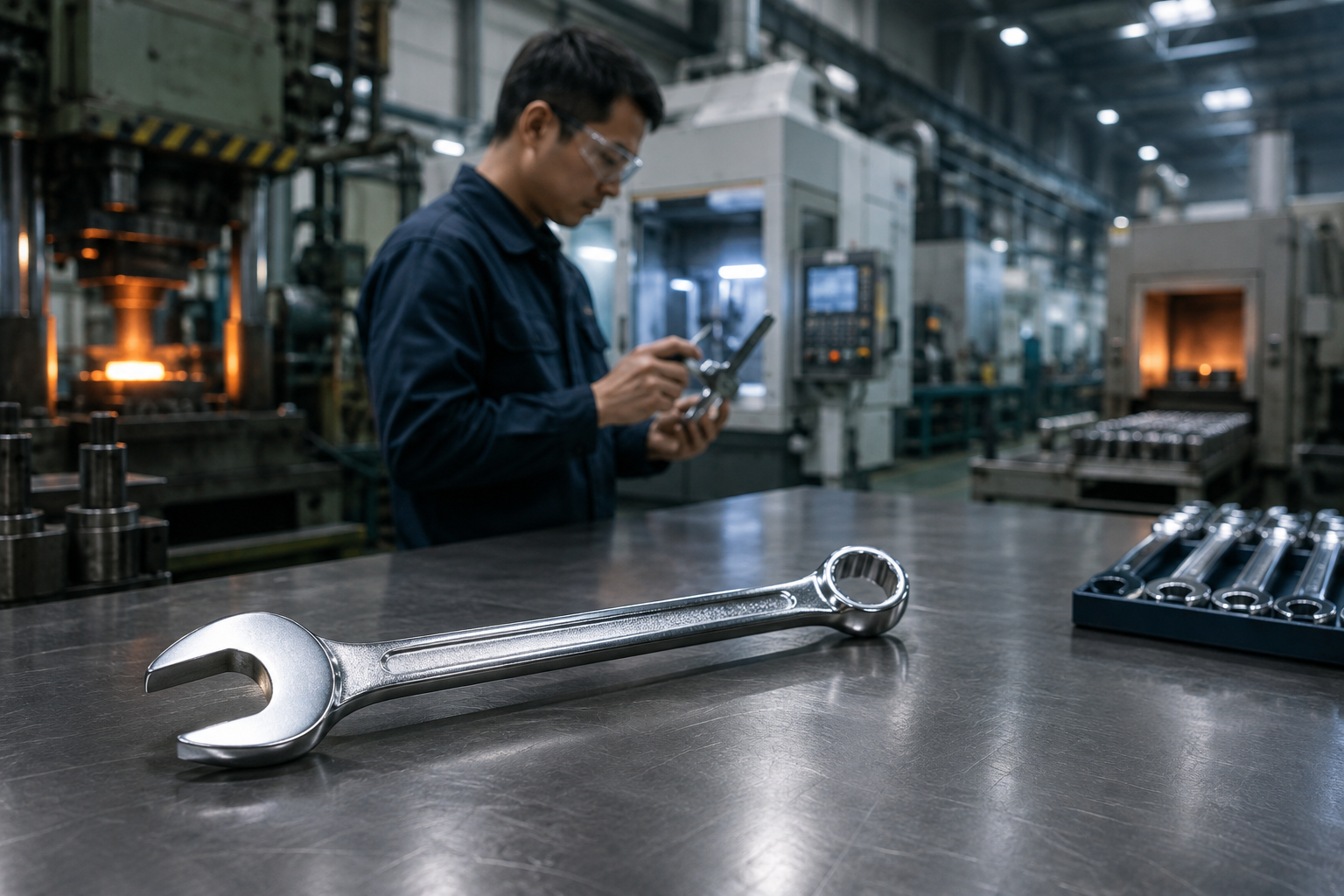
Behind One Wrench: How Taiwan’s Hand Tool Manufacturing Cluster Creates Global Value
A wrench may look like a simple product. For an international buyer, however, sourcing one under a private label can involve far more than selecting a size and requesting a quotation.
The buyer may need to define the steel grade, forging method, hardness range, torque performance, heat treatment, surface finish, dimensional tolerance, handle design, marking, packaging, testing requirements, order quantity, and replenishment schedule.
This is where Taiwan’s hand tool manufacturing ecosystem becomes valuable. Taiwan is not simply a place where finished tools are assembled; it is an interconnected supply chain capable of turning detailed requirements into repeatable commercial products.
Taiwan’s Position in the Global Hand Tool Market
Taiwan has built a significant export industry around hand tools for professional, industrial, automotive, construction, hardware, and consumer markets.
More than 90% of these businesses have fewer than 50 employees. This structure reveals a defining characteristic of Taiwan manufacturing: the industry is composed largely of specialized small and medium-sized enterprises (SMEs) rather than a small number of vertically integrated giants.
That structure directly supports:
- Specialized technical knowledge within individual processes
- Flexible production across multiple product types
- Cooperation between nearby factories and processors
- OEM, ODM, and private-label programs
- Low-volume, high-mix production when commercially feasible
- Faster coordination among tooling, metalworking, finishing, testing, and packaging partners
What Is Behind the Production of One Wrench?
A typical forged wrench project involves several highly coordinated technical stages:
Material Selection
The steel specification influences strength, toughness, wear resistance, machining behavior, and cost. Required material grades, acceptable alternatives, and verification procedures must be clarified during the RFQ stage.
Forging & Forming
Forging creates basic geometry and mechanical properties. Die condition, process control, and dimensional consistency affect both appearance and downstream machining.
Heat Treatment
Critical to achieving intended hardness. Soft tools deform; brittle tools fracture. Hardness ranges, testing methods, and sampling plans must be predefined.
Machining & Dimensional Control
Open-end geometry, box-end profiles, and ratcheting mechanisms require precise machining. Dimensional tolerances should be clearly defined through approved drawings or standards.
Surface Finishing
Chrome plating, satin finish, black oxide, and phosphate coatings impact corrosion resistance, grip, and visual appeal.
Marking & Private-Label Customization
Brand names, size markings, laser engraving, stamping, and packaging artwork must be coordinated carefully, confirming which costs are included in the quote.
Inspection, Testing & Packaging
Covers hardness, torque, load, coating thickness, and functional testing, followed by retail cards, blow-molded cases, master cartons, and barcodes.
The Cluster Is Strong—but Not Every Factory Is the Right Factory
A trading company may present itself as a manufacturer. A factory that excels at forging may depend heavily on external partners for finishing or packaging. Finding a supplier name is only the first step. Overseas buyers must verify in-house vs. subcontracted capabilities, material traceability, tooling ownership, and testing standards before committing.
What Should a Hand Tool RFQ Include?
Sending only a product photo and requested quantity often results in inaccurate quotations. A complete RFQ must cover:
Why the Lowest Unit Price May Not Be the Best Offer
The lowest quoted unit price often excludes new tooling fees, corrosion testing, custom markings, export packaging, or sample development charges. Rework, delayed shipments, or quality failures will quickly erase short-term savings. Buyers should evaluate total landed cost and supplier capability, not unit price alone.
How Jin-Kuang Supports Hand Tool Sourcing in Taiwan
Jin-Kuang helps international buyers translate commercial product ideas into structured sourcing requirements that Taiwanese suppliers can evaluate accurately.
We handle supplier discovery, RFQ organization, bilingual communication, capability reviews, sample coordination, and quality inspection.
Explore Our Taiwan Sourcing Services
Leave a Reply