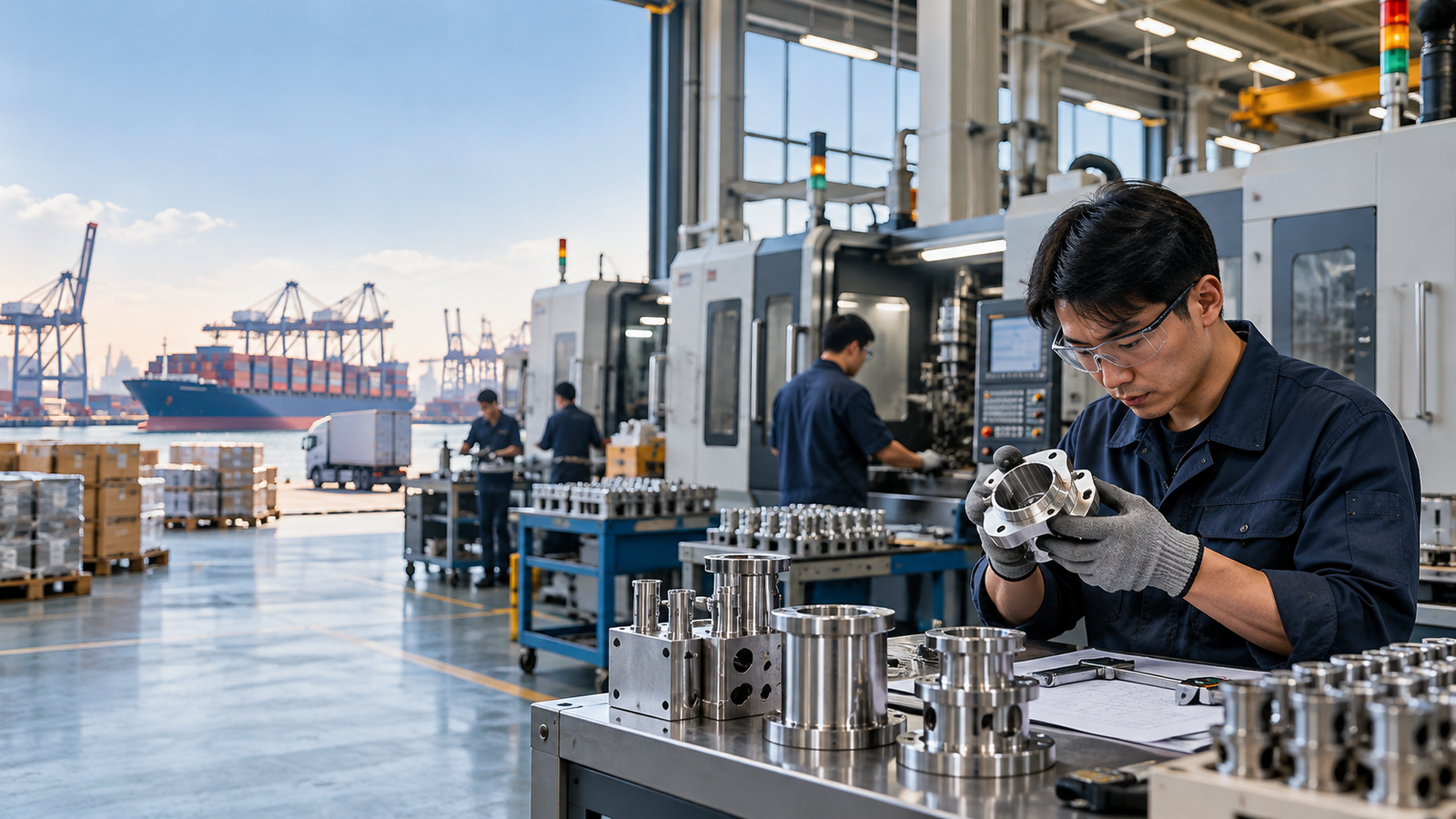
Taiwan Sourcing Guide: How to Find, Evaluate, and Manage Manufacturing Suppliers
Finding a manufacturer is only the first step. A reliable sourcing process turns a product requirement into a verified supplier relationship—with clear specifications, comparable quotations, controlled samples, quality expectations, and realistic delivery plans.

Key Takeaways
- Start with Clear Specs: Define precise technical requirements rather than issuing generic price requests.
- Standardize Evaluation: Qualify candidates against consistent technical, commercial, quality, and delivery metrics.
- Verify On-Site Realities: Inspect production sites, subcontracted workflows, quality systems, and export experience.
- Validate Before Mass Production: Lock down sample approvals and formal acceptance criteria prior to release.
- Focus on Total Landed Cost: Account for supply risk, tooling, duty, and logistics instead of unit price alone.
- Maintain Active Development: Implement continuous change control, performance tracking, and contingency backups.
1. What Strategic Sourcing Really Means
Sourcing is the structured framework of establishing a sustainable manufacturing partnership. While procurement handles commercial transactions (POs, contracts, and payments), strategic sourcing lays the operational foundation:
- Candidate Discovery: Identifying potential manufacturing partners through verified channels.
- Technical Screening: Checking factory equipment, engineering capabilities, and site suitability.
- RFQ Normalization: Aligning quotation terms across all shortlisted candidates.
- Process Validation: Testing physical samples and auditing quality control gates.
- Relationship Management: Setting up long-term communication and improvement frameworks.
For custom manufactured goods, sourcing decisions extend far beyond initial purchase prices. Key operational areas affected include:
- Product Consistency & Quality: Defect prevention and dimensional stability.
- Lead Times & Engineering Responsiveness: Speed during design iterations or production shifts.
- Asset Ownership & IP Security: Clear legal boundaries for tooling and proprietary designs.
- Supply-Chain Resilience: Recovery capability when regional disruptions or material shortages arise.
A disciplined process begins by defining specific project goals:
- Seeking a lower-cost primary supplier
- Establishing a qualified second source for risk mitigation
- Expanding existing production capacity
- Developing a completely new OEM/ODM component line
2. Why Consider Taiwan for Industrial Sourcing?
Taiwan is a globally recognized manufacturing hub, supported by dense industrial clusters and strong international trade infrastructure.
- Taiwantrade Platform: Operated by TAITRA (Taiwan External Trade Development Council), providing a B2B discovery starting point.
- Macro Export Volume: Taiwan’s Ministry of Finance reported ~$640.7 billion in 2025 exports, driven by advanced ICT, AI supply chains, and industrial machinery.
- Domestic Manufacturing Density: High integration between primary factories and specialized local subcontractors.
Where Taiwan Excels as a Strategic Sourcing Destination
- Precision & Metal Components: High process capability for CNC turning, stamping, forging, casting, and surface finishing.
- Industrial Hardware & Tools: Turnkey production requiring metalworking, heat treatment, testing, and custom retail packaging.
- Machinery & Equipment: Technical assemblies requiring close engineering dialogue and long-term after-sales support.
- Custom OEM/ODM Development: End-to-end partner collaboration working from drawings, CAD models, or functional prototypes.
3. Build a Sourcing Brief Before Contacting Suppliers
Incomplete specifications lead to incomparable supplier quotes. Before reaching out to factories, structure a comprehensive brief covering:
- Product Definition: 2D drawings, 3D CAD files, BOM, exact dimensions, tolerances, raw material grades, surface finishes, and revision tracking.
- Performance & Compliance: Load/torque limits, operating temperature ranges, testing methods, environmental standards (RoHS/REACH), and target market certifications.
- Commercial Quantities: Prototype batch size, trial order volume, annual volume forecasts, and expected production ramp-up.
- Packaging & Branding: Barcode labeling, custom retail boxes, master carton specs, and palletization standards.
- Commercial Terms: Currency (USD/TWD), Incoterms® (FOB/DDP), payment terms, tooling budgets, and quotation validity windows.
- Project Timeline: Sample delivery deadline, testing approval window, mass production launch, and target delivery dates.
- IP Protection Framework: Execute Non-Disclosure Agreements (NDAs), establish access controls, and clarify tooling ownership early.
4. Find Suppliers Through Multiple Channels
Diversify search methods to avoid over-relying on basic search engine results or sponsored vendor directories:
- Trade Platforms: Taiwantrade and specialized B2B industry portals for verified supplier profiles.
- Industry Associations & Expos: Sector-specific manufacturing guilds and trade shows (e.g., TIMTOS, TAIPEI AMPA).
- Referrals & Supply Networks: Recommendations from trusted engineering firms, component makers, or logistics partners.
- Targeted Process Searching: Search by specific manufacturing processes (e.g., “5-axis CNC stainless turning Taiwan”) rather than generic product names.
- Local Sourcing Support: On-the-ground consultants who provide bilingual technical screening and bridge cultural/time-zone gaps.
5. Qualify the Supplier, Not Just the Website
Always verify whether a contact is a direct factory, a trading company, or a hybrid supplier. Evaluate candidates using a structured qualification framework:
- Legal & Financial Verification: Business registration, facility address, bank account consistency, and operational history.
- Manufacturing Scope: In-house machinery lists, production lines, engineering staff, and reliance on external subcontractors.
- Quality Management Systems: On-site inspection tools, calibration records, material traceability, nonconformance handling, and ISO scope.
- Capacity & Continuity: Available machine hours, peak season bottlenecks, maintenance schedules, and labor stability.
- Communication & Responsiveness: Technical comprehension, speed of communication, and structured engineering change management.
6. Issue a Comparable RFQ and Normalize the Quotes
Ensure all suppliers receive identical, revision-controlled RFQ documentation. Normalize quotes line-by-line across these crucial variables:
- Scope of Quotation: Confirm whether quotes include raw materials, tooling, surface treatment, testing, packaging, and export documentation.
- Commercial Assumptions: Compare Minimum Order Quantities (MOQs), price tiers, payment milestones, and quotation validity periods.
- Incoterms® Rules: Specify exact named ports (e.g., FOB Keelung, DDP Los Angeles) to standardize freight and risk boundaries.
Total Landed Cost Breakdown
Unit price represents only a fraction of total procurement expenditure. Calculate total landed cost by factoring in:
- Tooling amortization & sampling costs
- Inland transport & ocean/air freight charges
- Customs duties, import tariffs, and brokerage fees
- Destination handling & warehouse inventory carrying costs
- Administrative overhead & quality inspection costs
7. Validate Samples Before Mass Production
Never treat physical samples as a mere formality. Establish rigid validation protocols before releasing production POs:
- Define Sample Milestones: Differentiate clearly between Engineering Prototypes, Off-Tool Samples, Pre-Production Samples, and Golden Samples.
- Formal Approval Records: Document drawing revision levels, measured critical dimensions, surface finishes, and approved engineering deviations.
- Tooling Management Terms: Define tooling ownership, maintenance cycles, storage conditions, and transfer rights if the relationship ends.
- Engineering Change Control (ECN): Establish strict protocols governing how material or process substitutions must be pre-approved.
8. Manage Production, Quality, and Logistics
Maintain active operational oversight throughout the production lifecycle:
- Milestone Progress Tracking: Require physical production photos or videos tied to schedule milestones rather than verbal assurances.
- Structured Quality Gates: Implement During Production (DUPRO) checks, Pre-Shipment Inspections (PSI), and certified lab testing.
- Pre-Shipment Verification: Audit master carton packaging, barcode accuracy, shipping marks, and customs documentation prior to release.
9. Manage Supply-Chain Risk and Responsible Sourcing
Build long-term resilience by implementing risk-proportionate oversight and ethical standards:
- Operational Due Diligence: Review single-source dependencies, long-lead raw materials, and subcontractor reliability.
- OECD Responsible Business Conduct: Audit labor practices, environmental compliance, material safety, and workplace standards.
- Supply Resilience Planning: Qualify backup suppliers and maintain clear specifications to withstand regional disruptions.
10. Common Sourcing Mistakes to Avoid
- Selecting purely on lowest quote: Omission of testing, poor packaging, or unrealistic delivery expectations.
- Issuing vague specifications: Incomplete CAD prints leading to engineering misalignments.
- Equating ISO certificates with product quality: Failing to perform product-specific testing.
- Bypassing formal sample validation: Authorizing mass production based on non-representative prototypes.
- Neglecting subcontractor inspection: Ignoring third-party heat treatment, plating, or machining steps.
- Leaving tooling ownership undefined: Failing to legally secure tooling rights and maintenance specs.
11. A Practical 30-Day Supplier Development Plan
12. How Jin-Kuang Can Support Taiwan Sourcing
Jin-Kuang International Consultants provides bilingual, on-the-ground execution to streamline your Asian manufacturing operations:
- Targeted Factory Discovery: Identifying verified Taiwanese manufacturers matching your specific specs.
- RFQ Organization & Normalization: Translating CAD prints and auditing line-item quotes.
- Cross-Border Communication: Managing technical dialogue, sample evaluations, and ECN tracking.
- Quality & Logistics Oversight: Coordinating pre-shipment inspections and export logistics partners.
Need Expert Support Sourcing in Taiwan?
Let Jin-Kuang help you turn complex manufacturing requirements into predictable, high-quality Asia supply chain relationships.
Explore Sourcing Services Contact Jin-KuangConclusion
Reliable sourcing is not a single supplier search or a price comparison. It is a sequence of evidence-based decisions: define the requirement, identify appropriate candidates, verify capability, compare equivalent quotations, approve representative samples, control production, and review performance over time. Taiwan can be a valuable part of that strategy for many industrial and OEM categories, but the right outcome depends on matching the specific supplier to the specific job—and validating that match before making a major commitment.
Frequently Asked Questions
How do I find manufacturers in Taiwan?
Start with a detailed sourcing brief, then combine trade platforms such as Taiwantrade with industry associations, trade shows, referrals, and targeted research by product and manufacturing process. Verify every candidate against the actual project requirements.
What information should I include in an RFQ?
Include drawings and revision levels, materials, tolerances, finishes, quantities, testing and compliance requirements, packaging, target timing, requested delivery terms, and a clear list of what the supplier must include in its quotation.
Is the lowest supplier price the best option?
Not necessarily. Compare total landed cost, quality risk, tooling, lead time, logistics, inventory implications, and the cost of managing or correcting problems—not unit price alone.
Should I audit a supplier before ordering?
The depth of verification should match product risk, order value, and consequences of failure. For critical or unfamiliar products, consider a site audit or independent assessment alongside document review, sample testing, and reference checks.
Can a sourcing partner guarantee supplier quality?
No sourcing process can guarantee that every future shipment will be defect-free. A sourcing partner can help structure supplier discovery, verification, communication, and quality checkpoints, but responsibilities, inspection scope, and limitations should be agreed explicitly.
Works Cited
- Ministry of Finance, Taiwan. Annual External Trade Report in 2025. February 23, 2026.
- Taiwan External Trade Development Council (TAITRA). Taiwantrade. Official platform overview; publication date not stated.
- Organisation for Economic Co-operation and Development (OECD). Due diligence for responsible business conduct. Official guidance page; publication date varies by linked resource.
- OECD. Responsible business conduct. Includes the six-step risk-based due-diligence framework; page accessed October 2026.
- National Institute of Standards and Technology (NIST). Cybersecurity Supply Chain Risk Management: Due Diligence Assessment Quick-Start Guide (SP 1326). July 2026.
- U.S. Department of Commerce, International Trade Administration. Trade.gov. Official trade and market-entry resources; consult current guidance for destination-specific requirements.
- International Chamber of Commerce. Incoterms® Rules. Official overview of international commercial terms.
Leave a Reply